Study published on Public Sector Open Source Program Offices
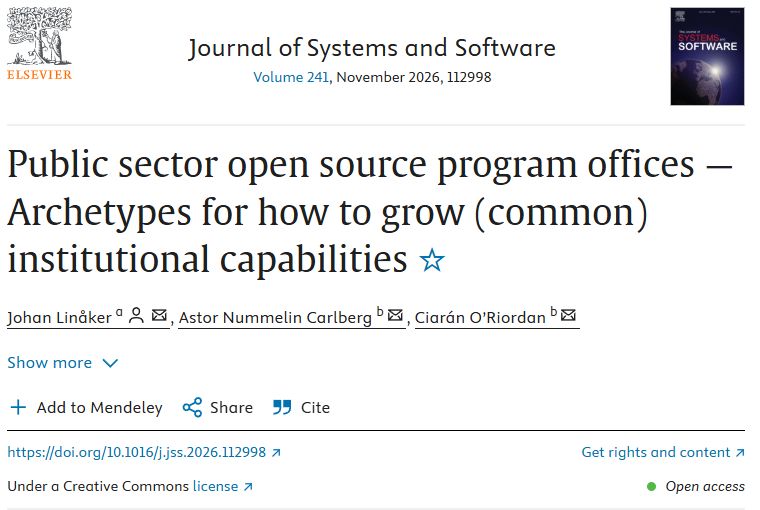
Our study “Public sector open source program offices - Archetypes for how to grow (common) institutional capabilities” is now officially published, and right in time for OSPOs for Good and the UN Open Source Week.
At its core, an Open Source Program Office (OSPO) is a support function or centre of competence that helps organisations adopt, develop, and collaborate on open source in a structured and sustainable way - aligned with policy goals and digital transformation efforts. Public sector globally and across Europe are increasingly looking to adopt OSPOs, something also promoted in the recently proposed EU Cloud and AI Development Act.
In the study, we looked across Europe at how public sector organisations are actually setting this up in practice. Based on interviews and case studies of OSPOs across different countries and levels of government, we identified a set of recurring patterns - six archetypes - that capture how these capabilities are organised and scaled.
Rather than a one-size-fits-all model, the picture that emerges is an ecosystem:
- national-level OSPOs shaping strategy and enabling reuse at national scale
- institution-centric OSPOs building internal capability for single organisations
- local government OSPOs driving service delivery and innovation in municipalities and regional governments
- association-based OSPOs pooling resources across public sector, especially municipalities
- academic OSPOs linking open source with open science at universities and research institutes
- and civil society actors complementing and sometimes filling gaps not attended by public sector
Together, these archetypes show how open source capability is not just built within single organisations – but collectively and across networks of actors.
A key takeaway from both the study and the paper is that the main barriers are rarely technical. They are about knowledge, culture, and resources - and this is exactly where OSPOs play a role as enablers and change agents.
For practitioners in the public sector, a few reflections stand out:
- Policy ambitions need institutional support to become real
- Building shared capabilities - across organisations - is often more effective than going alone
- Collaboration across levels (local, national, EU) and sectors (academia, civil society, industry) is essential
- And perhaps most importantly: start from your context, connect to others, and evolve incrementally
In that sense, OSPOs are less about “doing open source” and more about building the capacity to work openly - and doing so in a way that is sustainable, collaborative, and aligned with broader public value. You can read a more expansive summary in an earlier blog post.
The study, co-authored with Astor Nummelin Carlberg and Ciarán O’Riordan, with funding from the European Commission’s DG DIGIT to OpenForum Europe and RISE Research Institutes of Sweden through the OSOR project with Wavestone SA.