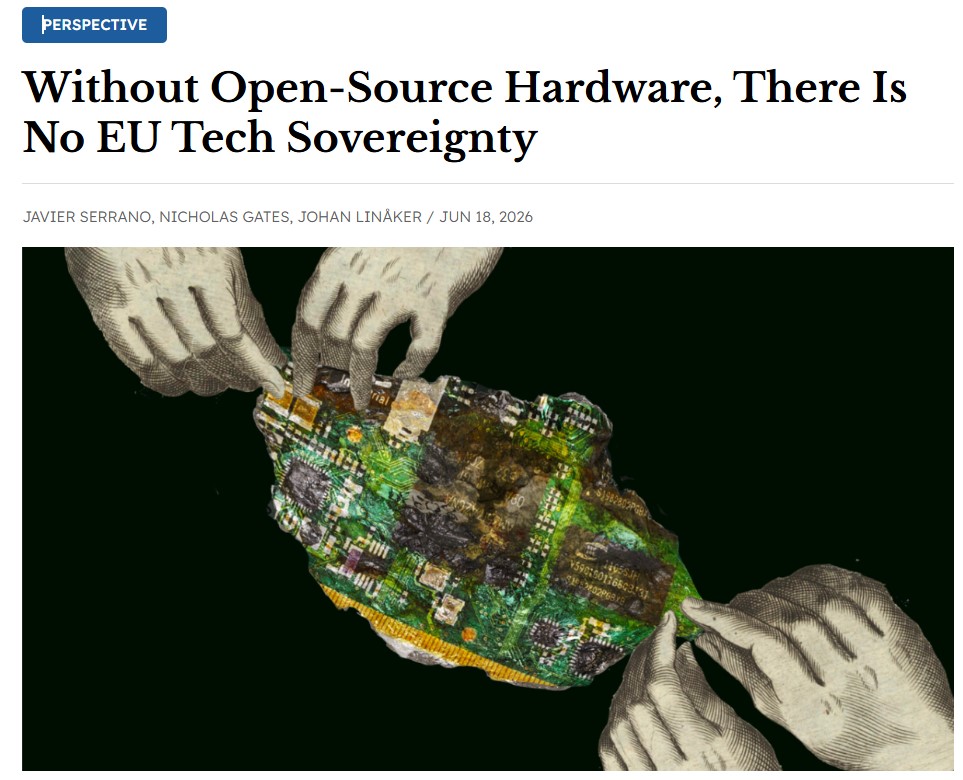
Without Open-Source Hardware, There Is No EU Tech Sovereignty
We talk a lot about tech sovereignty both in- and outside of Europe, but the discussion remains heavily focused on software.
In this TechPolicy.press op-ed, co-authored between Javier Serrano (European Open Source Academy (EOSA)), Nicholas Gates (OpenForum Europe) and I, we argue that this is only part of the picture. True sovereignty is a full-stack challenge, where open source hardware is key.
While Europe often frames hardware sovereignty in terms of manufacturing and supply chains, far less attention is given to the design layer where key dependencies actually sit: chip architectures, IP blocks, and EDA toolchains. These are largely controlled by non-European actors and create structural dependencies that are harder to escape than in software.
Open source has already shown how to reduce lock-in and enable collaboration in software. The same principles apply to hardware, with added importance. Opening up design lowers barriers to entry, enables broader participation, and creates the conditions for building sovereign capability over time.
We further highlight that the challenge is not just technical but institutional. Europe needs to invest in skills and absorptive capacity, ensuring organisations can actually adopt, use, and contribute to open technologies. Without this, policy ambitions will not translate into real capability.
We point to the need for stronger support for open EDA tools, sustained investments into academia and R&D, and more coordinated efforts to build ecosystems rather than fragmented initiatives.
Finally, while the EU’s recent Tech Sovereignty Package marks an important step and places open source more centrally in policy, it still largely focuses on software and higher layers. Open source hardware - and the deeper layers of the stack - remain under-addressed.
Europe needs to start looking beyond software, and treat open source hardware as a foundational part of the strategy, not an afterthought.